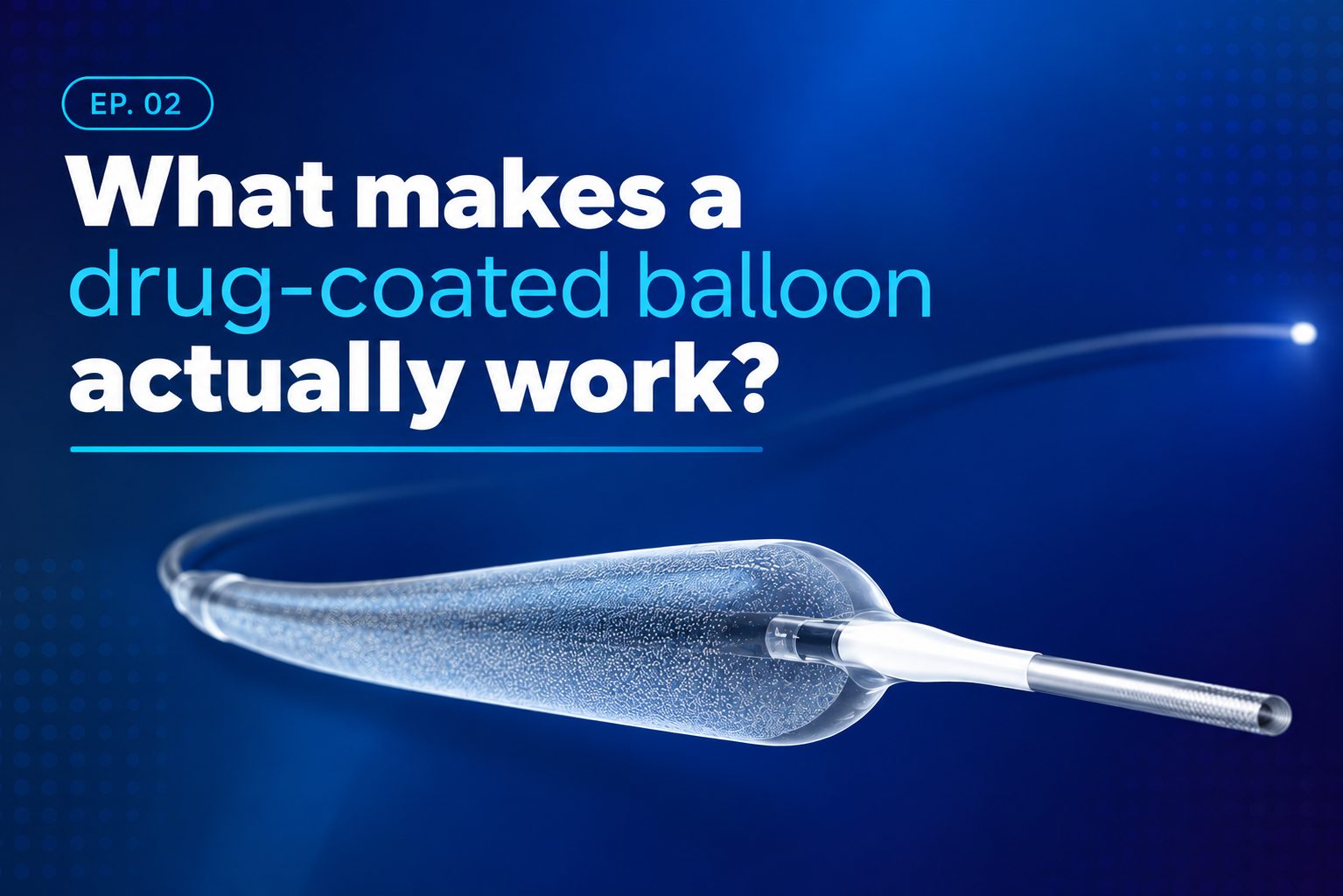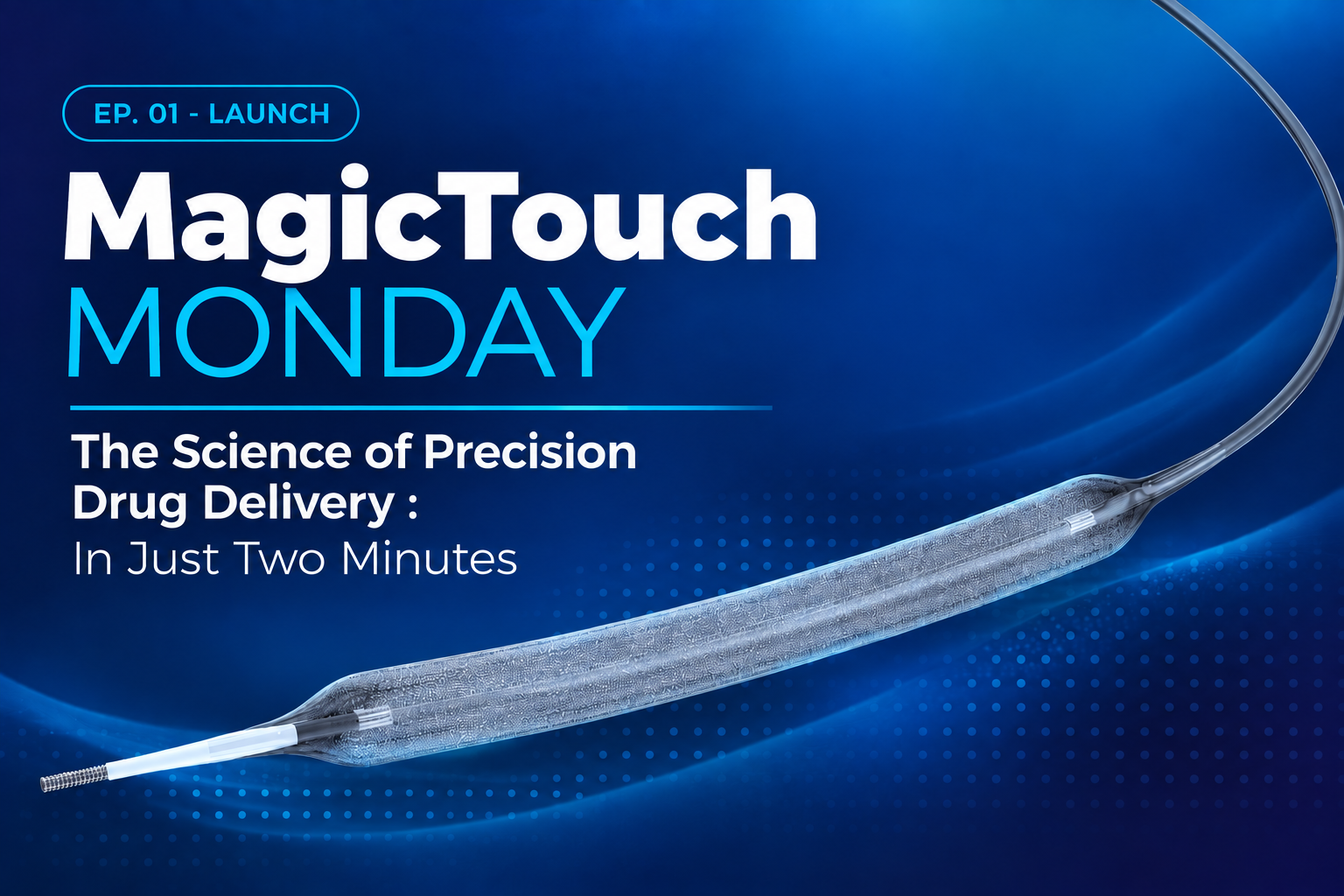
Beyond the drug: understanding the role of carriers and coating in precision drug delivery.
Discover how Nanolute Technology and the circumferential coating approach used in MagicTouch are designed to support drug protection, transfer and delivery to the vessel wall during a brief balloon inflation
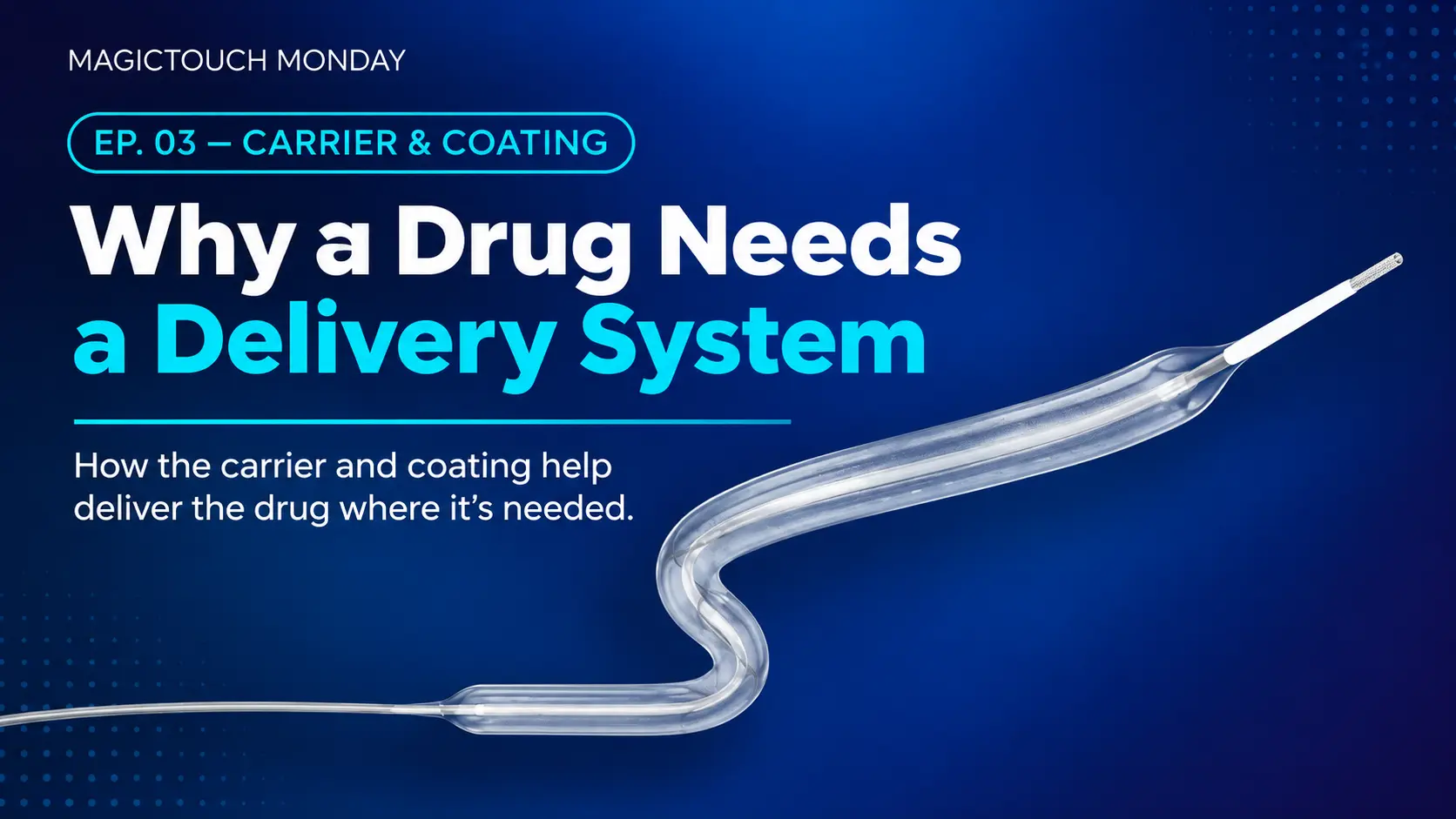
Why a drug-coated balloon needs more than just the right drug
A drug-coated balloon is only as effective as its ability to carry the drug and deliver it where it is needed. The drug needs to remain associated with the balloon during transit, transfer to the vessel wall during a brief inflation, and remain at the intended site after the balloon is removed.
So, what makes that possible?
The answer begins with the carrier and coating.
The Problem: You Can’t Just Paint a Drug on a Balloon
A drug cannot simply be placed on a balloon and expected to reach the vessel wall exactly as intended.
During the journey to the lesion, the drug needs to remain associated with the balloon. Once the balloon reaches the target site, the drug needs to transfer into the vessel wall during a single, brief inflation. It then needs to remain in the tissue after the balloon has been retrieved.
That creates several challenges within a very short window.
A bare drug cannot do that alone. It needs a carrier.
The Unsung Hero: Meet the Carrier
Alongside the drug, a drug-coated balloon carries another important component: the formulation that holds the drug and supports its delivery.
The carrier can influence how the drug is held on the balloon, how it behaves during transit, and how it is released when the balloon reaches the treatment site.
The drug gets the attention. The carrier does the work.
What Does a Carrier Need to Do?
Four Jobs, One Short Window
A carrier has to support several stages of drug delivery:
HOLD
Keep the drug on the balloon as it travels to the lesion.
PROTECT
Help limit wash-off while the balloon moves through flowing blood.
TRANSFER
Support release and transfer of the drug into the vessel wall during a single, brief inflation.
STAY
Help the drug remain in the tissue after balloon retrieval so its intended activity can continue.
Together, these four functions describe the challenge of delivering a drug from a temporary device to a specific treatment site.
The Journey: Track. Inflate. Transfer. Stay.
The drug-delivery process can be understood as a short but important sequence.
First, the balloon is tracked to the target lesion. It is then inflated briefly, bringing the drug-coated surface into contact with the vessel wall.
The drug is designed to transfer into the vessel wall. Then the balloon comes out, leaving nothing behind but the drug.
The entire hand-off takes place within seconds, making the delivery system an important part of drug-coated balloon design.
Coating Integrity: What’s on the Balloon Should Reach the Wall
The coating is another critical part of the delivery process.
A coating is only useful if the drug associated with it reaches the intended treatment site. If too much of the coating is lost during transit, less drug may be available for transfer when the balloon reaches the vessel wall.
An appropriate carrier is designed to help maintain the coating during the journey and support its release when the balloon reaches the target site.
In simple terms:
What’s on the balloon should reach the wall.
Different by Design: Carriers Take Different Forms
There is more than one way to design a drug-delivery system. Different carriers can hold the drug in different ways and control how it is released, while working toward the same overall goal: delivering the drug to the vessel wall and helping it stay there.
Surface Coating
The drug is carried as a film on the balloon.
Reservoirs
The drug is held within small reservoirs and released from them.
Encapsulation
Individual drug particles are wrapped within a carrier for the journey.
Each approach represents a different engineering strategy for drug delivery.
Our Approach: Engineered to Deliver
MagicTouch uses Nanolute Technology as its drug-delivery approach.
MagicTouch carries sirolimus in Nanolute using sub-micron drug particles wrapped in a biocompatible phospholipid the same family of molecules found in cell membranes.
The approach is built around one central idea:
Get the drug to the wall and help it stay.
MagicTouch SCB uses circumferential coating technology designed to support homogeneous drug distribution.
The Takeaway
Judge a balloon by its delivery not just its drug.
The delivery system involves four pillars:
Together, these elements help explain how a drug-coated balloon is designed to carry the drug to the intended treatment site and support its transfer and retention.
For MagicTouch, these elements come together through sirolimus and Nanolute technology, with a circumferential coating designed to support homogeneous drug distribution.
Continue the Journey
References
[1] MagicTouch SCB — Sirolimus-Coated Balloon Catheter
Concept Medical. Product and technology information.
https://www.conceptmedical.com/magictouch-scb/
[2] MagicTouch SCB — Clinical Evidence
Concept Medical. Clinical evidence and research programme.
https://www.conceptmedical.com/magictouch-scb-drug-coated-balloon-clinical-evidence/
Disclaimer
For Healthcare Professionals Only. This content is provided for educational purposes only and is not intended as medical advice. MagicTouch approved indications and product availability may vary by region. MagicTouch is not approved for commercial use in the United States. Please refer to the applicable local product labelling and Instructions for Use for complete information.